

FUJITSU MONAKA:
Inside the 2nm Sovereign AI Platform
AI infrastructure is no longer only a GPU discussion. Power, cooling, memory bandwidth, data control, security and workload placement are becoming equally important. Fujitsu MONAKA introduces a new CPU and server architecture aimed directly at those constraints.
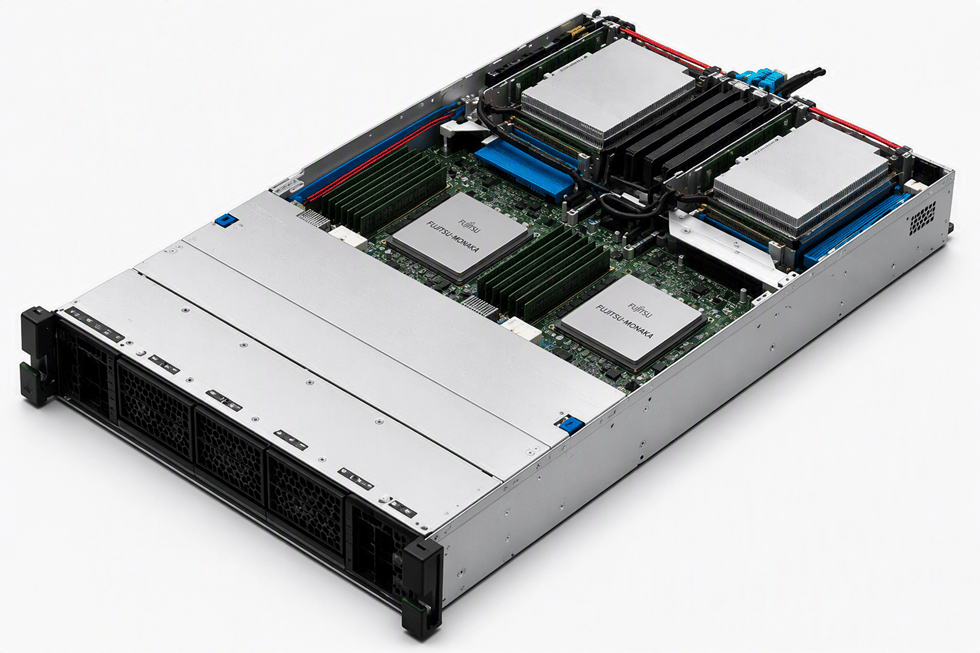
On September 14, 2026, Fujitsu announced global sales of FUJITSU-MONAKA and the new Fujitsu MONAKA Server. The launch is important because it is not being positioned as another general-purpose CPU refresh. Fujitsu is connecting the processor to a broader idea: sovereign AI infrastructure that combines efficient compute, traceable manufacturing, confidential computing, resource pooling, networking and enterprise AI software.
A CPU launch — and a much larger infrastructure story.
Fujitsu says FUJITSU-MONAKA will begin global sales in November 2026, including standalone processor sales to cloud providers, data-center operators and server vendors. The MONAKA Server brings the processor into a Made-in-Japan server platform aimed at AI inference, AI agents, enterprise computing and HPC.
The timing matters. Generative AI is pushing data centers into hard physical limits: available electrical capacity, cooling, floor space and the cost of moving data between systems. At the same time, enterprises and public institutions are asking how to keep sensitive data, AI models and operational control inside trusted environments.
Inference without assuming GPU-first.
MONAKA adds dedicated matrix acceleration and SVE2 vector processing so selected inference workloads can run efficiently on the CPU.
More performance inside tighter power limits.
Fujitsu positions performance per watt as a design objective, not an afterthought.
Control extends below the software layer.
Manufacturing traceability, confidential computing and local operating control become part of the architecture conversation.
ComputingEra view: the AI infrastructure question is changing from “Which accelerator is fastest?” to “Which combination of compute, memory, storage, network, data and AI software gives the right performance, control and economics for this workload?”
2nm cores, 3D chiplets and a design built around data movement.
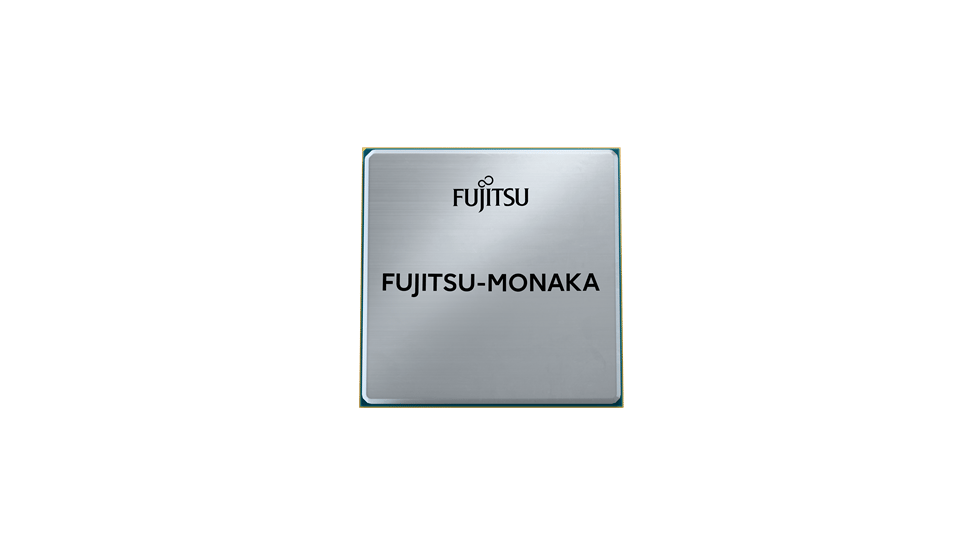
Fujitsu technical materials describe MONAKA as a high-core-count Arm processor using a 3D chiplet architecture: 2nm core dies combined with 5nm SRAM/cache and I/O dies. The design uses Arm SVE2 for vector processing and supports Confidential Computing through Arm CCA.
The architecture is also built for high data supply: Fujitsu lists 12-channel DDR5 memory and PCI Express 6.0 / CXL 3.0 support. That matters because modern AI and data-processing workloads are often limited not only by arithmetic performance but by how quickly processors can access and move useful data.
More than a process-node headline.
Fujitsu combines its 2nm core die with 5nm cache and I/O chiplets, 144 Arm cores per socket in current technical materials, high-bandwidth DDR5, PCIe 6.0/CXL 3.0, SVE2 vector processing and dedicated AI matrix operations.
*Core count, socket count, SVE2 width and memory-channel details come from Fujitsu technical materials and remain subject to change as the product moves through its rollout.
Does MONAKA replace the GPU? That is the wrong question.
MONAKA is especially interesting because Fujitsu is explicitly positioning CPU-only inference as practical for selected AI workloads. Dedicated matrix instructions, SVE2 and software optimization are intended to improve inference throughput while avoiding the power and infrastructure profile of GPU-heavy systems where that level of acceleration is not required.
Where MONAKA can make architectural sense
- Enterprise RAG and controlled inference
- AI agents and automation services
- Data processing close to databases
- Latency-sensitive and irregular workloads
- Power-constrained edge or private AI
- General compute mixed with AI services
Where accelerators remain essential
- Large-model training
- Massively parallel deep-learning workloads
- Image, video and signal processing at scale
- High-throughput tensor-heavy processing
- Large-scale multimodal model workloads
- Workloads optimized for CUDA ecosystems
The likely enterprise architecture is heterogeneous: CPU for latency-sensitive, data-centric and control-heavy work; GPU for highly parallel accelerator workloads; shared memory, storage and network engineered around both.
The server design turns processor efficiency into data-center economics.
The MONAKA Server is designed, developed and manufactured in Japan. Fujitsu says production at its Kasashima Plant provides visibility into component origin and manufacturing history, strengthening traceability and supply-chain transparency.
1–2 CPUs
Compact rack-mount configuration designed for inference and AI-agent workloads.
2 CPUs
More per-node headroom for enterprise compute and AI workloads.
2U multi-node
Four nodes with two CPUs each for academic and HPC workloads.
CDI / CXL
Allocate memory and accelerators beyond a single physical server boundary.
Cooling becomes part of the product story.
For the 1U system, Fujitsu states operation up to 40°C ambient with air cooling and support for 45°C water temperatures with water cooling. Fujitsu also claims up to 80% lower server cooling power consumption under its comparison conditions.
This matters because AI expansion often fails at the facility layer before it fails at the compute layer. If existing air-cooled rooms can host useful AI capacity without a complete cooling redesign, the economics and deployment timeline can change materially.
MONAKA is one layer of Fujitsu's full-stack sovereign strategy.
Fujitsu's technology strategy connects the MONAKA processor and server to an AI software layer. The goal is not sovereignty through hardware alone, but a controlled stack from networking and compute through models, agents, RAG and AI security.
Sovereign AI = software + infrastructure
Fujitsu technology strategy
Software & intelligence
Compute & network
Security
Protect data, AI models and AI-agent communications.
Flexibility
Adapt infrastructure and AI services as requirements change.
Domain-specific focus
Build platforms around sector-specific operating requirements.
Sovereignty is also about protecting data while it is being processed.
Encryption at rest and encryption in transit are familiar. Confidential computing addresses the third state: data in use. Fujitsu says MONAKA applies Arm Confidential Compute Architecture (CCA), using hardware mechanisms to protect data and applications in memory even from highly privileged software layers.
For financial services, government, healthcare and multi-tenant platforms, that changes the security model. Sensitive workloads can be designed around stronger isolation boundaries while still using shared infrastructure.
Start with workload characteristics — not with the product name.
MONAKA is new, so the right enterprise approach is to identify candidate workloads and benchmark them rather than assume a universal fit. Fujitsu highlights AI inference, AI agents, cloud, data analytics and HPC. From a ComputingEra perspective, the strongest early discussions are likely to be workloads where power, locality, security and infrastructure control matter together.
A staged rollout, not a single global release event.
Fujitsu's September announcement describes a staged launch. FUJITSU-MONAKA standalone CPU sales begin in November 2026, with global expansion including the US and APAC. The MONAKA Server is introduced in Japan and Europe, with selected financial, telecommunications and manufacturing use cases during the second half of FY2026 and sequential shipments from April 2027.
| Milestone | Fujitsu direction |
|---|---|
| November 2026 | FUJITSU-MONAKA sales begin; MONAKA Server launch activities begin in Japan and Europe. |
| H2 FY2026 | Selected financial, telecom and manufacturing customer programs expand use cases. |
| From April 2027 | Sequential MONAKA Server shipments in Japan and Europe. |
| 2029 roadmap | MONAKA-X moves to 1.4nm and expands AI acceleration, including tighter CPU/GPU integration. |
For Saudi Arabia and the GCC, regional availability should be confirmed for each project. ComputingEra can help evaluate architecture and workload fit while the product roadmap and regional commercialization develop.
Don't optimize one component. Design the system.
The next generation of enterprise AI infrastructure will not be defined by GPUs alone, CPUs alone, or any single platform. The winning architecture connects Data + Compute + Network + Storage + AI as one system and places each workload where the technology creates the most value.
Keep transactional data reliable. Bring active data closer to compute. Execute workloads where the data lives. Minimize unnecessary data movement. Add semantic retrieval where AI requires it. Then expose the right context securely to AI applications and agents.
How we would evaluate MONAKA for an enterprise
Start with the application and data path. Then validate the infrastructure.
Assess before you scale.
Bring us your AI inference, RAG, agent, data or HPC workload. We can evaluate where MONAKA may fit — technically, operationally and economically — as part of your broader AI infrastructure architecture.
www.computingera.cominfo@computingera.com
+966 9200 32901
Riyadh, Saudi Arabia
FUJITSU MONAKA:
Inside the 2nm Sovereign AI Platform
AI infrastructure is no longer only a GPU discussion. Power, cooling, memory bandwidth, data control, security and workload placement are becoming equally important. Fujitsu MONAKA introduces a new CPU and server architecture aimed directly at those constraints.
On September 14, 2026, Fujitsu announced global sales of FUJITSU-MONAKA and the new Fujitsu MONAKA Server. The launch is important because it is not being positioned as another general-purpose CPU refresh. Fujitsu is connecting the processor to a broader idea: sovereign AI infrastructure that combines efficient compute, traceable manufacturing, confidential computing, resource pooling, networking and enterprise AI software.
A CPU launch — and a much larger infrastructure story.
Fujitsu says FUJITSU-MONAKA will begin global sales in November 2026, including standalone processor sales to cloud providers, data-center operators and server vendors. The MONAKA Server brings the processor into a Made-in-Japan server platform aimed at AI inference, AI agents, enterprise computing and HPC.
The timing matters. Generative AI is pushing data centers into hard physical limits: available electrical capacity, cooling, floor space and the cost of moving data between systems. At the same time, enterprises and public institutions are asking how to keep sensitive data, AI models and operational control inside trusted environments.
Inference without assuming GPU-first.
MONAKA adds dedicated matrix acceleration and SVE2 vector processing so selected inference workloads can run efficiently on the CPU.
More performance inside tighter power limits.
Fujitsu positions performance per watt as a design objective, not an afterthought.
Control extends below the software layer.
Manufacturing traceability, confidential computing and local operating control become part of the architecture conversation.
ComputingEra view: the AI infrastructure question is changing from “Which accelerator is fastest?” to “Which combination of compute, memory, storage, network, data and AI software gives the right performance, control and economics for this workload?”
2nm cores, 3D chiplets and a design built around data movement.
Fujitsu technical materials describe MONAKA as a high-core-count Arm processor using a 3D chiplet architecture: 2nm core dies combined with 5nm SRAM/cache and I/O dies. The design uses Arm SVE2 for vector processing and supports Confidential Computing through Arm CCA.
The architecture is also built for high data supply: Fujitsu lists 12-channel DDR5 memory and PCI Express 6.0 / CXL 3.0 support. That matters because modern AI and data-processing workloads are often limited not only by arithmetic performance but by how quickly processors can access and move useful data.
More than a process-node headline.
Fujitsu combines its 2nm core die with 5nm cache and I/O chiplets, 144 Arm cores per socket in current technical materials, high-bandwidth DDR5, PCIe 6.0/CXL 3.0, SVE2 vector processing and dedicated AI matrix operations.
*Core count, socket count, SVE2 width and memory-channel details come from Fujitsu technical materials and remain subject to change as the product moves through its rollout.
Does MONAKA replace the GPU? That is the wrong question.
MONAKA is especially interesting because Fujitsu is explicitly positioning CPU-only inference as practical for selected AI workloads. Dedicated matrix instructions, SVE2 and software optimization are intended to improve inference throughput while avoiding the power and infrastructure profile of GPU-heavy systems where that level of acceleration is not required.
Where MONAKA can make architectural sense
- Enterprise RAG and controlled inference
- AI agents and automation services
- Data processing close to databases
- Latency-sensitive and irregular workloads
- Power-constrained edge or private AI
- General compute mixed with AI services
Where accelerators remain essential
- Large-model training
- Massively parallel deep-learning workloads
- Image, video and signal processing at scale
- High-throughput tensor-heavy processing
- Large-scale multimodal model workloads
- Workloads optimized for CUDA ecosystems
The likely enterprise architecture is heterogeneous: CPU for latency-sensitive, data-centric and control-heavy work; GPU for highly parallel accelerator workloads; shared memory, storage and network engineered around both.
The server design turns processor efficiency into data-center economics.
The MONAKA Server is designed, developed and manufactured in Japan. Fujitsu says production at its Kasashima Plant provides visibility into component origin and manufacturing history, strengthening traceability and supply-chain transparency.
1–2 CPUs
Compact rack-mount configuration designed for inference and AI-agent workloads.
2 CPUs
More per-node headroom for enterprise compute and AI workloads.
2U multi-node
Four nodes with two CPUs each for academic and HPC workloads.
CDI / CXL
Allocate memory and accelerators beyond a single physical server boundary.
Cooling becomes part of the product story.
For the 1U system, Fujitsu states operation up to 40°C ambient with air cooling and support for 45°C water temperatures with water cooling. Fujitsu also claims up to 80% lower server cooling power consumption under its comparison conditions.
This matters because AI expansion often fails at the facility layer before it fails at the compute layer. If existing air-cooled rooms can host useful AI capacity without a complete cooling redesign, the economics and deployment timeline can change materially.
MONAKA is one layer of Fujitsu's full-stack sovereign strategy.
Fujitsu's technology strategy connects the MONAKA processor and server to an AI software layer. The goal is not sovereignty through hardware alone, but a controlled stack from networking and compute through models, agents, RAG and AI security.
Sovereign AI = software + infrastructure
Fujitsu technology strategy
Software & intelligence
Compute & network
Security
Protect data, AI models and AI-agent communications.
Flexibility
Adapt infrastructure and AI services as requirements change.
Domain-specific focus
Build platforms around sector-specific operating requirements.
Sovereignty is also about protecting data while it is being processed.
Encryption at rest and encryption in transit are familiar. Confidential computing addresses the third state: data in use. Fujitsu says MONAKA applies Arm Confidential Compute Architecture (CCA), using hardware mechanisms to protect data and applications in memory even from highly privileged software layers.
For financial services, government, healthcare and multi-tenant platforms, that changes the security model. Sensitive workloads can be designed around stronger isolation boundaries while still using shared infrastructure.
Start with workload characteristics — not with the product name.
MONAKA is new, so the right enterprise approach is to identify candidate workloads and benchmark them rather than assume a universal fit. Fujitsu highlights AI inference, AI agents, cloud, data analytics and HPC. From a ComputingEra perspective, the strongest early discussions are likely to be workloads where power, locality, security and infrastructure control matter together.
A staged rollout, not a single global release event.
Fujitsu's September announcement describes a staged launch. FUJITSU-MONAKA standalone CPU sales begin in November 2026, with global expansion including the US and APAC. The MONAKA Server is introduced in Japan and Europe, with selected financial, telecommunications and manufacturing use cases during the second half of FY2026 and sequential shipments from April 2027.
| Milestone | Fujitsu direction |
|---|---|
| November 2026 | FUJITSU-MONAKA sales begin; MONAKA Server launch activities begin in Japan and Europe. |
| H2 FY2026 | Selected financial, telecom and manufacturing customer programs expand use cases. |
| From April 2027 | Sequential MONAKA Server shipments in Japan and Europe. |
| 2029 roadmap | MONAKA-X moves to 1.4nm and expands AI acceleration, including tighter CPU/GPU integration. |
For Saudi Arabia and the GCC, regional availability should be confirmed for each project. ComputingEra can help evaluate architecture and workload fit while the product roadmap and regional commercialization develop.
Don't optimize one component. Design the system.
The next generation of enterprise AI infrastructure will not be defined by GPUs alone, CPUs alone, or any single platform. The winning architecture connects Data + Compute + Network + Storage + AI as one system and places each workload where the technology creates the most value.
Keep transactional data reliable. Bring active data closer to compute. Execute workloads where the data lives. Minimize unnecessary data movement. Add semantic retrieval where AI requires it. Then expose the right context securely to AI applications and agents.
How we would evaluate MONAKA for an enterprise
Start with the application and data path. Then validate the infrastructure.
Assess before you scale.
Bring us your AI inference, RAG, agent, data or HPC workload. We can evaluate where MONAKA may fit — technically, operationally and economically — as part of your broader AI infrastructure architecture.
www.computingera.cominfo@computingera.com
+966 9200 32901
Riyadh, Saudi Arabia
Start writing here...