
Inside MariaDB + GridGain: Building a Low-Latency Data Platform for Agentic AI
A technical look at how transactional data, distributed in-memory computing, real-time processing, and AI retrieval can work together to support modern enterprise and agentic AI workloads.
The AI infrastructure problem isn't only the GPU
Enterprise AI discussions often begin with GPUs.
How many GPUs?
Which GPU architecture?
How much VRAM?
What interconnect?
How many inference requests per second?
Those are important questions.
But there is another question that is becoming equally important:
How quickly can the AI application get the right enterprise data?
An AI model can generate an answer in milliseconds, but if the application spends hundreds of milliseconds—or seconds—retrieving customer records, transactions, operational state, documents, embeddings, and business context, the overall application remains slow.
This is particularly important for real-time AI and agentic AI.
An AI agent may need to perform several operations before responding:
User Request
      │
      ▼
Understand Intent
      │
      ▼
Retrieve Enterprise Context
      │
      ├── Customer Data
      ├── Transactions
      ├── Operational State
      ├── Business Rules
      └── Semantic / Vector Search
      │
      ▼
Reason / Decide
      │
      ▼
Execute Action
      │
      ▼
Return Result
Every data movement step introduces latency.
This is where the combination of MariaDB and GridGain becomes interesting.
The objective is not simply to make MariaDB faster.
The objective is to create a distributed data architecture that brings persistent data, in-memory processing, and AI retrieval closer together.
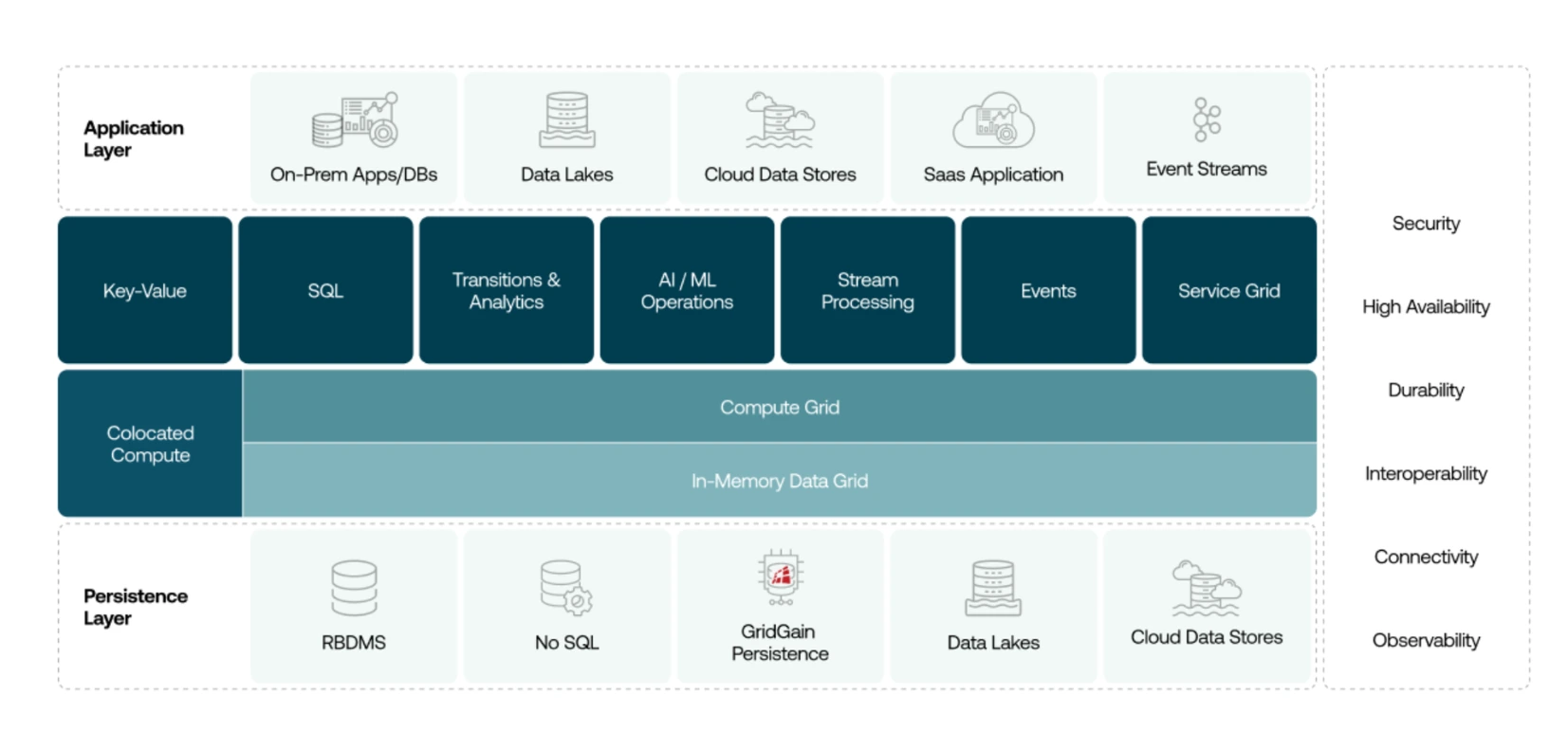
The Architecture in One Picture
At a high level, the architecture can be viewed as three logical layers:
                         AI / AGENT LAYER
              ┌─────────────────────────────────┐
              │ AI Agents │ RAG │ MCP │ AI Apps │
              └────────────────┬────────────────┘
                               │
                    Retrieval / Context
                               │
              ┌────────────────▼────────────────┐
              │      GRIDGAIN / IN-MEMORY       │
              │                                 │
              │ Partitioning                    │
              │ Replication                     │
              │ Colocation                      │
              │ Distributed Compute             │
              │ Real-Time Processing            │
              └────────────────┬────────────────┘
                               │
                     Persistent / SQL Data
                               │
              ┌────────────────▼────────────────┐
              │             MARIADB             │
              │                                 │
              │ ACID Transactions               │
              │ Relational Data                 │
              │ SQL                             │
              │ Operational Applications        │
              └─────────────────────────────────┘
The important architectural principle is:
One logical data architecture, minimizing unnecessary copies and ETL between transactional, in-memory, and AI workloads.
This does not mean that every deployment physically stores every piece of data in exactly one location.
Instead, MariaDB and GridGain can have complementary responsibilities while allowing applications to work against data with far less movement between disconnected platforms.
1. MariaDB: The Transactional Data Foundation
MariaDB provides the relational and transactional foundation.
For many enterprises, this is where the authoritative operational data resides:
Customers
Accounts
Orders
Products
Payments
Inventory
Employees
Transactions
Business processes
Application records
The database provides the characteristics enterprise systems depend on:
SQL + ACID transactions + relational integrity + persistence
That makes MariaDB a natural foundation for applications where correctness and transactional consistency matter.
But transactional persistence is not always the ideal execution environment for every real-time workload.
Consider a fraud engine evaluating a payment.
It may need to access:
Current account status
Customer profile
Recent transactions
Merchant information
Risk indicators
Historical behavior
Fraud rules
If every request requires multiple database round trips, the data-access path can become the bottleneck.
This is where the distributed in-memory layer enters the architecture.
2. GridGain: Bringing Data and Compute Together
GridGain is built around distributed in-memory computing.
At a conceptual level, GridGain allows data and computation to be distributed across a cluster of nodes.
Instead of building a centralized architecture where an application repeatedly retrieves data from a remote database, the workload can be organized so that:
The computation goes to the node where the required data already lives.
That principle is known as compute colocation.
And it is one of the most important concepts in the entire architecture.
3. Partitioning: Distributing the Data Across the Cluster
Large datasets cannot always be replicated completely across every node.
GridGain therefore supports distributed partitioning.
Consider a transaction table containing several billion records.
Instead of storing everything on every server:
              Transaction Dataset
                      │
       ┌──────────────┼──────────────┐
       ▼              ▼              ▼
    Node 01         Node 02        Node 03
    Partitions      Partitions     Partitions
       A-D            E-H            I-L
Each node owns a portion of the dataset.
As nodes are added, the cluster can increase aggregate memory and processing capacity.
This creates a fundamentally different scaling model:
Vertical scaling
Bigger server → more CPU/RAM
versus:
Horizontal scaling
More nodes → more distributed capacity
For high-volume real-time applications, horizontal scaling can be particularly attractive.
4. Replication: Putting Frequently Used Data Everywhere
Not every dataset needs to be partitioned.
Some tables are relatively small but accessed constantly.
Examples include:
Currency rates
Product catalogs
Configuration
Reference data
Fraud rules
Country codes
Business policies
For these datasets, replication can make more sense.
                 Reference Data
                      │
          ┌───────────┼───────────┐
          ▼           ▼           ▼
       Node 01      Node 02      Node 03
       Full Copy    Full Copy    Full Copy
Every node can access the required reference information locally.
This reduces unnecessary network traffic and simplifies high-frequency lookups.
5. Colocation: Where the Architecture Gets Interesting
Simply putting data in memory does not automatically create an optimal distributed architecture.
The more important question is:
Where is the computation executed?
Imagine a banking application evaluating a transaction.
The application needs:
Transaction
     +
Customer
     +
Account
     +
Risk Profile
     +
Recent Activity
If these records are scattered across different nodes, the cluster may need to exchange data over the network.
But if the related records are colocated using a common affinity key, such as Customer ID:
                    Customer 1001
                         │
              ┌──────────┼──────────┐
              ▼          ▼          ▼
           Account    Transactions   Risk
              │          │          │
              └──────────┼──────────┘
                         │
                    Same Node
                         │
                         ▼
                 Compute Locally
The computation can execute where the data resides.
That means fewer network round trips and less data movement.
This is a much more meaningful explanation of low latency than simply saying:
“RAM is faster than disk.”
The architecture is optimizing data locality.
6. Data + Compute: The Distributed In-Memory Model
This produces an important architectural pattern:
Traditional:

Application
     │
     ▼
Database
     │
     ▼
Retrieve Data
     │
     ▼
Application Compute


Distributed:

Application
     │
     ▼
GridGain Cluster
     │
     ├── Data
     ├── Compute
     └── Processing
Instead of moving large amounts of data to the application, the application can send computation toward the data.
This becomes especially valuable when the calculation involves large datasets.
7. Native Persistence: In-Memory Does Not Have to Mean "Everything Must Fit in RAM"
One of the common objections to in-memory architectures is simple:
RAM is expensive.
A second objection follows:
RAM is volatile.
GridGain's persistence capabilities address an important part of this challenge by allowing data to be persisted beyond memory.
This means memory can be designed around the active working set rather than assuming that the entire enterprise dataset must permanently fit into RAM.
Conceptually:
                 Full Dataset
                     │
        ┌────────────┴────────────┐
        │                         │
     Hot Data                 Historical Data
        │                         │
        ▼                         ▼
    IN MEMORY                 PERSISTED
    Fast Access               Durable Storage
The exact memory-to-data ratio should be determined from the workload rather than assuming a universal percentage.
The important architectural idea is:
Memory is optimized for active processing, while persistent storage retains the broader dataset.
8. SQL and Key-Value Access
Another important characteristic is that distributed data can be accessed through different programming models.
Applications may use low-latency key-based access for operations such as:
get(CustomerID)
get(AccountID)
get(OrderID)
while analytical or operational users can work with SQL:
SELECT customer_id,
       COUNT(*) AS transaction_count
FROM transactions
GROUP BY customer_id;
The important point is that these interfaces can operate against the same logical distributed dataset.
That reduces the need to create multiple disconnected copies simply because different applications require different access patterns.
9. Distributed Transactions
Performance alone is not enough for enterprise applications.
Financial systems, inventory platforms, payment systems, and other transactional workloads require correctness.
For example:
Debit Account A
      +
Credit Account B
      +
Record Transaction
      +
Update Risk State
The architecture must ensure that these operations are handled consistently.
Distributed transactional capabilities therefore become important when multiple pieces of data are involved.
This is one of the areas where an in-memory platform moves beyond the traditional concept of a simple cache.
10. Where AI Enters the Architecture
Now we reach the most interesting part.
Modern enterprise AI needs access to more than documents.
It needs context.
For example, an AI banking assistant may need:
Customer Profile
       +
Account Balance
       +
Recent Transactions
       +
Product Information
       +
Policies
       +
Relevant Documents
       +
Semantic Search
A traditional RAG architecture may introduce multiple systems:
Application
   │
   ├── SQL Database
   │
   ├── Vector Database
   │
   ├── Cache
   │
   ├── Document Store
   │
   └── Search Engine
Every additional system introduces another integration point.
The alternative is to move toward a more unified data architecture.
11. Vector Search: Giving AI Semantic Context
Modern AI applications frequently represent documents or other information as vectors.
A simplified model looks like this:
Document
   │
   ▼
Embedding Model
   │
   ▼
Vector
   │
   ▼
Vector Store
When a user asks a question, the question can also be converted into an embedding.
The system then searches for the most semantically similar information.
Conceptually:
SELECT id,
       content,
       metadata
FROM knowledge_chunks
ORDER BY vector_distance(embedding, :query_embedding)
LIMIT :k;
The AI system receives the most relevant context and can use it to construct its response.
This is the foundation of Retrieval-Augmented Generation (RAG).
12. Why Combining Vector and Operational Data Matters
Consider an enterprise AI assistant answering:
"Should we approve this customer's transaction?"
A vector search may retrieve:
Credit policy
Fraud policy
Internal procedures
Regulatory documentation
But the agent also needs live operational information:
Current balance
Recent transactions
Customer status
Risk score
The AI application therefore needs both:
Semantic context
and
Operational context
A modern data architecture should make it possible to retrieve both efficiently.
That is where the combination of transactional data, distributed processing, and vector retrieval becomes powerful.
13. MCP: Connecting AI Agents to Enterprise Data
The next layer is the Model Context Protocol (MCP).
MCP provides a standardized mechanism through which AI applications and agents can interact with external tools and data sources.
In an enterprise data environment, an MCP interface can expose capabilities such as:
Database schema discovery
SQL execution
Data retrieval
Vector search
Enterprise context
The architecture becomes:
                 AI Agent
                    │
                    ▼
                   MCP
                    │
          ┌─────────┴─────────┐
          │                   │
       SQL Data          Vector Search
          │                   │
          └─────────┬─────────┘
                    ▼
              Data Platform
                    │
              MariaDB + GridGain
This changes the role of the database.
It is no longer simply a backend that applications query.
It becomes part of the context layer for AI agents.
14. Agentic AI: From Retrieval to Action
The real opportunity is not only RAG.
Agentic AI systems can reason, retrieve information, make decisions, and initiate actions.
Consider an AI agent supporting a retail operation:
Customer asks:
"Can I get this product tomorrow?"
          │
          ▼
Agent retrieves inventory
          │
          ▼
Checks warehouse location
          │
          ▼
Checks delivery capacity
          │
          ▼
Evaluates historical delivery patterns
          │
          ▼
Generates recommendation
          │
          ▼
Creates / updates order
This workflow requires a combination of:
Real-time operational data + historical data + semantic information + business rules + AI reasoning
A distributed data architecture can reduce the friction between these components.
15. Worked Example: Real-Time Dispatch Optimization
Consider a Saudi quick-commerce or food-delivery platform.
Thousands of riders continuously change location and availability.
An order arrives.
The system needs to find the best rider.
Step 1 — Live rider state
Rider location and availability are maintained in distributed data structures.
Zone Riyadh-01
 ├── Rider 102
 ├── Rider 215
 ├── Rider 308
 └── Rider 417
Step 2 — Partition by geography
Rider data can be distributed according to an appropriate geographic or business key.
Step 3 — Colocated processing
The incoming order can trigger computation near the relevant rider data.
The system evaluates:
Distance
Current availability
Estimated delivery time
Current workload
Historical performance
Step 4 — SQL analytics
Operations teams can query the same logical data for:
Rider density
Average delivery time
Zone utilization
Demand patterns
Step 5 — AI optimization
An AI agent can use live operational information together with historical patterns and semantic context to recommend dispatch decisions.
The important architectural principle is:
The AI system is not reasoning over yesterday's export. It can be grounded in current operational context.
16. The Same Pattern in Saudi Banking
Replace the rider with a banking transaction.
The system receives:
ATM / POS / Mobile Transaction
The platform retrieves:
Customer
+
Account
+
Transaction History
+
Risk Profile
+
Fraud Rules
+
Real-Time Signals
The system can then calculate a risk score.
The AI layer can additionally provide contextual reasoning:
“This transaction differs from the customer's normal behavior because the location, amount, and transaction frequency differ from the established pattern.”
This is where distributed data infrastructure and AI become complementary.
The GPU may perform the model inference.
But the data platform feeds the model with the context it needs.
17. AI Acceleration Is Not Just GPU Acceleration
This distinction deserves emphasis.
A modern AI platform has several layers:
                 AI Applications
                       │
                 AI Agents / RAG
                       │
                Model Inference
                       │
                   GPU / CPU
                       │
             AI Data / Retrieval
                       │
             GridGain / In-Memory
                       │
                    MariaDB
                       │
               Enterprise Storage
GPU acceleration optimizes the model computation.
Data acceleration optimizes the path that supplies the model with information.
A system can have extremely powerful GPUs and still deliver poor application performance if its data retrieval architecture is inefficient.
Therefore:
AI infrastructure should be designed around compute, network, storage, and data together.
18. MariaDB + GridGain vs. a Fragmented AI Data Stack
A traditional enterprise AI architecture can easily evolve into:
OLTP Database
      │
      ▼
ETL / CDC
      │
      ▼
Data Warehouse
      │
      ▼
Vector Database
      │
      ▼
AI Application
      │
      ▼
Cache
Each layer has a purpose.
But each layer also introduces:
Data movement
Synchronization
Operational complexity
Multiple security boundaries
Additional monitoring
Additional failure points
Potential data freshness problems
The alternative is not necessarily to eliminate every specialized component.
Rather, it is to ask:
How many copies of the same data do we actually need?
MariaDB + GridGain provides an architecture for reducing unnecessary duplication where the workload benefits from distributed in-memory processing.
19. What Each Technology Does
| Capability | MariaDB | GridGain |
|---|---|---|
| Relational database | ✓ | |
| SQL | ✓ | ✓ |
| ACID transactions | ✓ | ✓ |
| Persistent operational data | ✓ | ✓* |
| Distributed in-memory processing | ✓ | |
| Partitioned data | ✓ | |
| Replicated data | ✓ | |
| Data colocation | ✓ | |
| Low-latency key/value access | ✓ | |
| Distributed compute | ✓ | |
| Vector / AI retrieval | ✓** | ✓** |
| AI / MCP integration | ✓ | ✓ |
* Depending on architecture and deployment model.
** Capabilities and implementation depend on the specific product versions and deployment architecture.
The point is not that one technology replaces the other.
The point is that they can solve different layers of the same data problem.
20. What About Oracle Exadata or Teradata?
This architecture does not have to begin with a database replacement.
For many enterprises, the sensible starting point is workload modernization.
For example:
             Existing Enterprise Database
                  Oracle / Teradata
                         │
             ┌───────────┴───────────┐
             │                       │
      Core Transactions       High-Latency Workloads
             │                       │
             │                       ▼
             │                GridGain Layer
             │                       │
             │                Real-Time AI
             │                Fraud / Risk
             │                Personalization
             │                Agentic Workloads
             │
             ▼
        Existing Systems
Organizations can identify workloads where latency, throughput, or data movement is becoming a problem and introduce the distributed in-memory layer selectively.
This creates a path toward modernization without requiring a “big bang” database migration.
21. What About Apache Ignite?
For organizations already running Apache Ignite, the discussion is different.
GridGain is built around the Apache Ignite technology lineage and provides an enterprise distribution and commercial ecosystem around that technology.
For an organization operating self-managed Ignite, the decision therefore becomes less about learning an entirely different architectural model and more about evaluating:
Enterprise support
Product capabilities
Security
Operations
Lifecycle management
Commercial support
Migration requirements
Regional implementation capability
This is particularly relevant for enterprises that need production support and local expertise.
22. Where This Architecture Fits Best
The architecture is particularly interesting when applications require a combination of:
High transaction volumes
Large numbers of operational events need to be processed continuously.
Low latency
The application cannot tolerate long database round trips.
Large working sets
A significant portion of operational information needs to be accessed repeatedly.
Real-time analytics
The business needs current information rather than yesterday's batch data.
AI retrieval
AI applications need both structured and semantic information.
Agentic workflows
AI agents need to retrieve information and potentially initiate business actions.
Horizontal scalability
The workload needs to grow by adding nodes rather than continuously scaling a single server.
23. Where It May Not Be the Right Architecture
A good architecture discussion should also identify where the technology is not the right answer.
MariaDB + GridGain should not automatically be introduced simply because an organization is adopting AI.
If the workload is:
Small
Low volume
High latency tolerant
Primarily batch oriented
Rarely accessed
Already well served by an existing architecture
then introducing another distributed platform may add unnecessary complexity.
The architecture becomes compelling when latency, throughput, data locality, real-time processing, or AI context retrieval justify the additional platform.
That distinction is important.
The goal is not to put GridGain everywhere.
The goal is to put distributed in-memory computing where it solves a real architectural problem.
24. The Saudi Enterprise Opportunity
Saudi Arabia is entering a period where AI adoption is moving rapidly from experimentation toward production.
Organizations across:
Banking
Government
Telecom
Healthcare
Retail
Logistics
Manufacturing
Energy
Fintech
are looking at AI not simply as an analytics tool, but as part of operational applications.
That creates a different infrastructure requirement.
AI needs access to live enterprise data.
For many Saudi organizations, the challenge will therefore move from:
“How do we build an AI model?”
to:
“How do we safely and efficiently connect AI to our operational data?”
This is where a distributed data architecture can become strategically important.
25. From Database Modernization to AI Data Infrastructure
The broader trend is clear.
Enterprise data architectures are moving from:
Database
    ↓
Application
toward:
Transactional Data
       ↓
Distributed Data
       ↓
Real-Time Processing
       ↓
AI Retrieval
       ↓
AI Reasoning
       ↓
Business Action
MariaDB can provide the transactional foundation.
GridGain can provide distributed in-memory processing and data locality.
AI and MCP technologies can provide the interface between enterprise data and intelligent applications.
Together, these capabilities create a path toward an AI-ready data platform.
26. The ComputingERA Architecture View
At ComputingERA, we believe the next generation of enterprise AI infrastructure will not be defined by GPUs alone.
The winning architecture will connect:
Data + Compute + Network + Storage + AI
in a single design.
For database architects and platform teams, MariaDB + GridGain provides an interesting pattern:
Keep transactional data reliable. Bring active data closer to compute. Execute workloads where the data lives. Reduce unnecessary data movement. Add semantic retrieval where AI requires it. Then expose that context safely to AI applications and agents.
That is a very different proposition from simply adding a cache to a database.
It is a move toward a distributed data platform for real-time and agentic applications.
Conclusion
AI applications are becoming increasingly data-intensive.
The model itself is only one component.
The application also needs fast access to operational state, historical information, business rules, documents, and semantic context.
MariaDB + GridGain provides an architectural approach for bringing these requirements closer together.
MariaDB provides the relational and transactional foundation.
GridGain provides distributed in-memory data and compute capabilities.
Vector search provides semantic retrieval.
MCP provides a standardized path for AI applications and agents to interact with enterprise data.
And the combination creates a potential architecture in which AI applications can work against fresh operational context instead of relying exclusively on replicated or batch-generated data.
The key principle is simple:
Don't only accelerate the AI model. Accelerate the data path that feeds the AI.
For enterprises preparing for real-time and agentic AI, that may be one of the most important infrastructure decisions of the next generation.
How ComputingERA Can Help
ComputingERA can help organizations evaluate where distributed in-memory computing fits within an existing data architecture—from Oracle Exadata and Teradata environments to MariaDB and Apache Ignite deployments.
Our approach is workload-driven:
Assess → Architect → Benchmark → Modernize
Rather than starting with a product, we start with the workload.
We examine:
Current database architecture
Transaction volume
Latency requirements
Data-access patterns
Working-set size
Network architecture
AI and vector-search requirements
Integration requirements
High-availability requirements
Existing Oracle, MariaDB, Teradata, or Ignite investments
The result is an architecture based on the organization's actual requirements—not a generic benchmark.