
How ComputingEra Helps Organizations Transform Odoo into a Secure, Resilient and Scalable Enterprise Platform
Organizations no longer evaluate ERP systems based solely on accounting functionality or inventory management. Today's enterprise leaders must also consider platform resilience, cybersecurity, cloud strategy, AI readiness, scalability, operational continuity, integration, and long-term flexibility.
Odoo has rapidly emerged as one of the world's fastest-growing ERP platforms because it delivers an integrated, modular, and cost-effective business application suite. However, enterprise success depends on far more than selecting the right ERP software.
The architecture on which the ERP runs ultimately determines its ability to support mission-critical operations.
At ComputingEra, we believe enterprise ERP should be delivered as a complete cloud-native platform, not simply installed as an application. By combining Odoo with enterprise technologies such as Red Hat OpenShift, Kubernetes, PostgreSQL, enterprise storage, backup, monitoring, automation, cybersecurity, and hybrid cloud infrastructure, we help organizations build ERP environments that are secure, resilient, scalable, and ready for future innovation.
This paper explores why Odoo is becoming the ERP of choice for modern organizations—and why the deployment architecture is equally important to long-term success.
The Enterprise ERP Landscape Is Changing
Twenty years ago, ERP projects were primarily about replacing legacy accounting software. Organizations accepted lengthy implementation cycles, expensive licensing models, and rigid architectures because there were few alternatives.
Today, business priorities are very different.
Organizations are expected to respond rapidly to changing market conditions, integrate new business models, adopt artificial intelligence, support distributed workforces, comply with evolving regulations, and continuously improve customer experience. Technology is no longer a support function—it is a strategic enabler.
In this environment, ERP systems must do far more than manage transactions. They must become the operational core of the digital enterprise.
Traditional ERP platforms often struggle to keep pace with these expectations. They can be expensive to scale, difficult to customize, tightly coupled to proprietary technologies, and slow to evolve.
Modern organizations increasingly seek platforms that are modular, API-driven, cloud-ready, and capable of integrating with the broader digital ecosystem.
This shift explains why Odoo has gained significant momentum.
Why Odoo Is Different
Odoo approaches ERP from a different perspective.
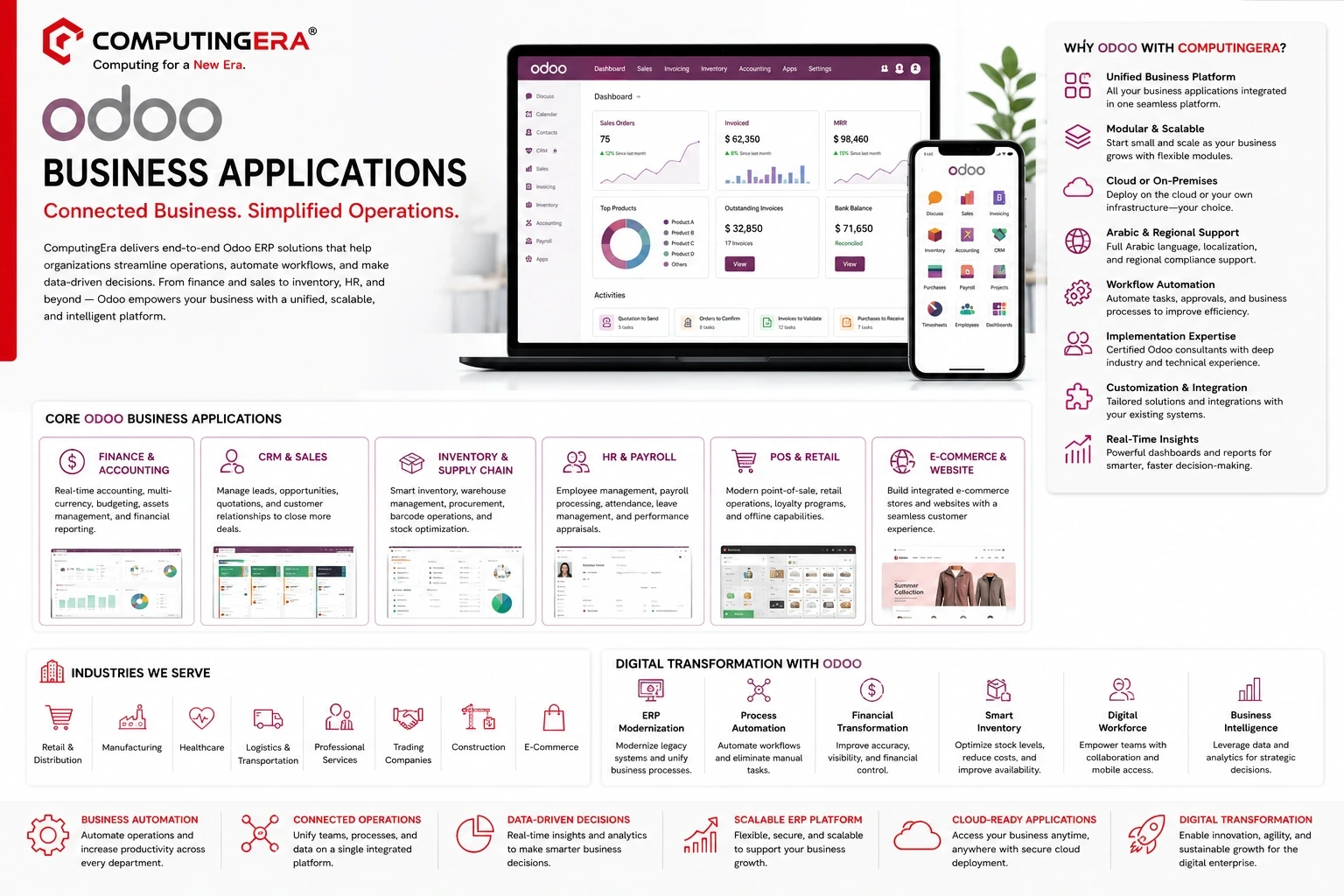
Rather than delivering a collection of independent products connected through complex integrations, Odoo offers a unified business platform built around a shared data model.
Its integrated application suite includes:
- Finance & Accounting
- CRM
- Sales
- Purchasing
- Inventory
- Manufacturing
- Quality
- Maintenance
- HR & Payroll
- Field Service
- Helpdesk
- Projects
- Website
- eCommerce
- Marketing Automation
- Subscription Management
- Rental
- Point of Sale
Every module shares the same business objects, eliminating duplicate data and reducing integration complexity.
This unified architecture allows organizations to digitize business processes gradually while maintaining a consistent user experience.
Odoo Is Only Part of the Solution
This is where many ERP discussions stop.
But enterprise architecture starts here.
Deploying Odoo successfully is not only about installing application modules. Enterprise organizations require operational characteristics that extend beyond the application itself.
These include:
- High availability
- Disaster recovery
- Secure identity integration
- Centralized logging
- Performance monitoring
- Backup and recovery
- Infrastructure automation
- Controlled upgrades
- Horizontal scalability
- Hybrid cloud portability
- Security hardening
- Compliance controls
These capabilities are not native features of Odoo.
They are delivered through the underlying platform, infrastructure, and architecture.
This distinction is extremely important.
Where ComputingEra Creates Value
At ComputingEra, our role extends well beyond ERP implementation.
We architect complete enterprise platforms that enable Odoo to operate reliably within demanding enterprise environments.
Our approach combines expertise in:
- Enterprise Infrastructure
- Cloud Architecture
- Kubernetes
- Red Hat OpenShift
- Enterprise Linux
- PostgreSQL
- High Availability
- Enterprise Storage
- Enterprise Networking
- Cybersecurity
- Disaster Recovery
- Monitoring
- Automation
- AI Integration

Rather than viewing ERP as a standalone application, we design an integrated technology platform that supports long-term business growth.
Why We Recommend Red Hat OpenShift
Many organizations ask:
"If Odoo already works, why introduce OpenShift?"
The answer is simple.
OpenShift does not replace Odoo.
It strengthens the environment in which Odoo operates.
OpenShift provides enterprise Kubernetes capabilities such as:
- Container orchestration
- Self-healing workloads
- Rolling application updates
- Declarative deployments
- GitOps workflows
- Integrated security policies
- Resource management
- Hybrid cloud portability
- Centralized operations
These capabilities improve operational resilience without changing the functional behavior of Odoo itself.
In other words:
Odoo delivers business functionality.
OpenShift delivers operational excellence.
Enterprise Cloud-Native ERP
ComputingEra designs Odoo deployments using cloud-native principles.
Typical enterprise architecture includes:
- Odoo Application Containers
- PostgreSQL Database
- Redis Cache
- NGINX or HAProxy Ingress
- Persistent Enterprise Storage
- Backup Platform
- Monitoring Platform
- Centralized Logging
- Identity Management
- CI/CD Pipelines
- GitOps
- Disaster Recovery Architecture
Each layer contributes to the stability of the complete ERP platform.
This architecture enables organizations to standardize ERP operations alongside other enterprise applications running within Kubernetes environments.
Scaling the Business—Not Just the Application
Growth introduces new technical challenges.
Organizations expand into:
- Multiple legal entities
- New countries
- Additional warehouses
- Manufacturing facilities
- Distribution centers
- Online channels
- Mobile workforces
Cloud-native architecture enables ComputingEra to support these evolving requirements through infrastructure designed for flexibility and operational consistency.
Scaling is achieved through thoughtful architectural design, capacity planning, workload distribution, and automation—not by assuming that every component scales automatically.
Security by Design
Enterprise ERP contains critical business information.
Protecting this data requires more than application permissions.
ComputingEra incorporates:
- Secure container platforms
- Network segmentation
- Role-Based Access Control
- Secret Management
- Image Security
- Vulnerability Management
- Identity Integration
- TLS Encryption
- Enterprise Backup
- Disaster Recovery Planning
Security becomes part of the architecture from day one.
Future-Ready for AI
Artificial Intelligence is transforming ERP.
Organizations increasingly require:
- Intelligent document processing
- Predictive analytics
- AI-powered customer service
- Workflow automation
- Business intelligence
- Enterprise search
- Knowledge assistants
Cloud-native architecture makes integrating these services significantly easier than traditional monolithic deployments.
ComputingEra helps organizations prepare their ERP platforms for this next generation of intelligent business applications.
Why Organizations Choose ComputingEra
Technology projects succeed because of architecture—not software alone.
Our team combines decade of experience across:
- Enterprise Linux
- Databases
- Storage
- Networking
- Kubernetes
- OpenShift
- Cybersecurity
- High Availability
- ERP
- Cloud Infrastructure
- AI Platforms
- Digital Transformation
This multidisciplinary expertise enables us to bridge the gap between business applications and enterprise infrastructure.
Final Thoughts
Odoo has earned its reputation as one of the most capable and flexible ERP platforms available today. Its modular design, integrated business applications, and open architecture make it an excellent choice for organizations seeking a modern ERP foundation.
However, enterprise success depends on more than selecting the right software.
It depends on deploying that software within an architecture that delivers resilience, security, operational consistency, and the flexibility to evolve with the business.
That is where ComputingEra creates value.
We do not simply implement Odoo.
We design, build, secure, automate, and operate enterprise-grade digital platforms that combine Odoo with cloud-native technologies such as Red Hat OpenShift, Kubernetes, enterprise databases, storage, monitoring, backup, and cybersecurity.
By bringing together business applications and enterprise infrastructure, we help organizations build ERP platforms that are not only fit for today's requirements but prepared for tomorrow's opportunities.
The future of ERP is not just cloud-based. It is cloud-native, resilient, intelligent, and architected for continuous innovation.
ComputingEra is helping enterprises build that future—today.